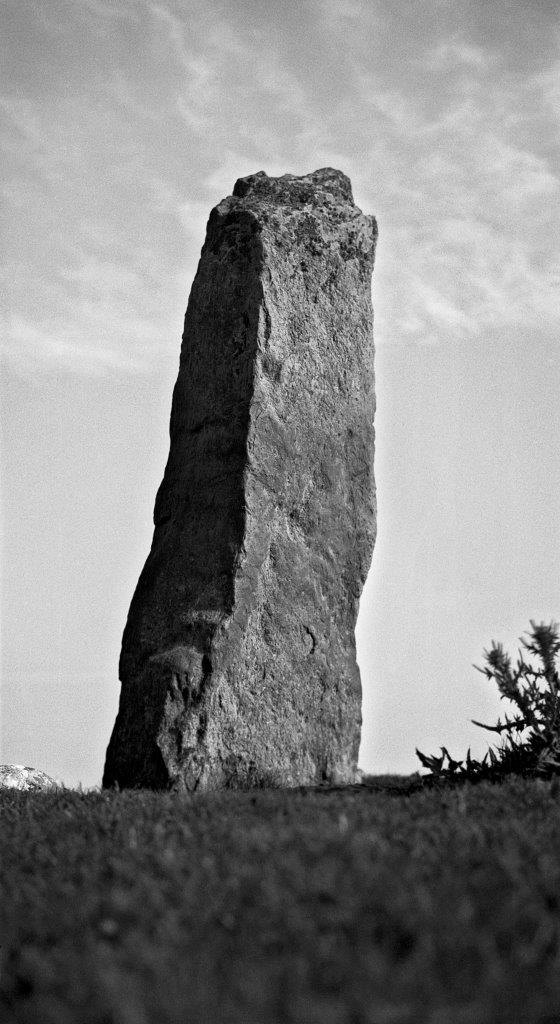
Standing Stone with Thistle

Story
This Neolithic standing stone thrusts toward the sky. Such monuments are amongst the many historic, archaeological and sacred sites Helen and Ernie O’Malley documented while traveling throughout Ireland in the late 1930s. Helen lay on the ground to take this shot looking toward the peak of the ancient menhir as a circular trough had been worn around its base by generations of cattle rubbing against it to scratch their hides.
Location
Killala, Co. Mayo
Date
1938
Order
BUY NOW   or   CUSTOM ORDER

Writing the Past, Ernie O’Malley

Story
Helen Hooker staged this photograph of Ernie O’Malley in her New York City studio apartment in February 1934 at the time she was sculpting him. She wrote her mother at that time saying, “Ernie O’Malley is posing for me for a portrait head and I wish I could catch something of his Irish charm and courageous spirit. I read one chapter of his novel of the experience in prison in Dublin and it was thrilling.”
Location
New York City
Date
1934
Order
BUY NOW   or   CUSTOM ORDER

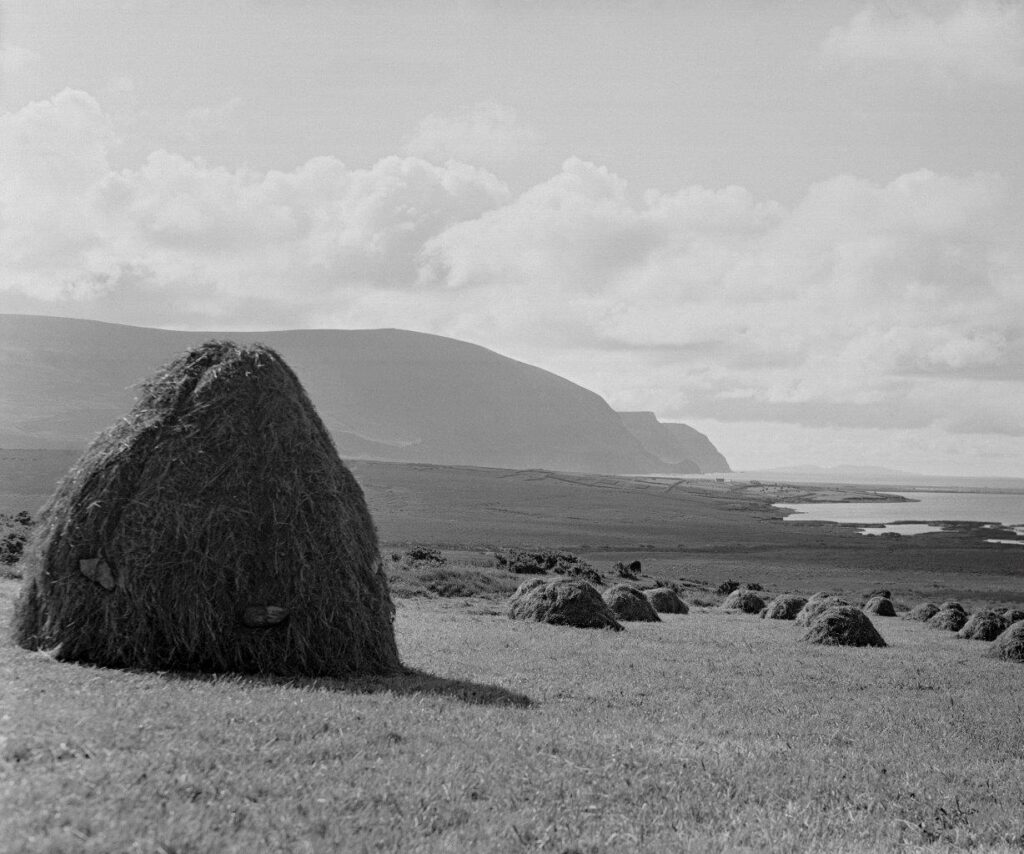
Haycocks and Minaun Cliffs

Story
The Minaun Cliffs, with a 1500-foot elevation, tower over the beaches by the village of Keel on Achill. This image is taken from the base of Slievemore Mountain looking south to Minaun. Clare Island rests beyond. The haycock in the forefront of this photograph is secured with hay ropes and anchored with stones. It illustrates the next-to-last step in the haying process that usually occurs in June or early July. In the 1930s, hay was still cut with a scythe and left on the ground to dry. After a few days, the farmers turned the hay with a pitchfork and later raked it into small stacks called haycocks. They then combined the rounded stacks into a larger haycock that was sometimes covered in cloth to protect it from the weather. Later in the summer, the farmers used pulleys and ropes to shift the enormous haycocks onto a wheeled wooden platform or “haycock shifter.” A horse would pull the haycock shifter to the farmyard.
Location
Achill Island, Co. Mayo
Date
1938
Order
BUY NOW   or   CUSTOM ORDER

Concrete Stile

Story
Helen Hooker O’Malley documented many aspects of Irish rural life. In this case, she photographed a stile through which people can wander from one field to the next without opening a gate or allowing livestock to escape. The concrete structure is one of many variants designed over the years and shows the juxtaposition of modern materials and traditional landscape. This is a theme Helen returns to time and again: history and the modern world.
Location
Co. Mayo
Date
1938
Order
BUY NOW   or   CUSTOM ORDER

Clare Island Annual Regatta

Story
The islanders watch the sailboat races intensely, sitting on a cliff overlooking Clare Island Harbor. Hookers (an húicéiri) were the intracoastal workhorses of the West of Ireland shipping trade. They were used for fishing and to transport people and cargo. Hookers are easily recognized by their black hulls and dark red-brown sails.
Location
Co. Mayo
Date
1938
Purchase
BUY NOW   or  CUSTOM ORDER

The Murrays of Clare island on Regatta Day

Story
Helen Hooker and Ernie O’Malley rented a house in Louisburgh, Co. Mayo in the summer of 1938. They travelled around Mayo including Clew Bay and its many islands. On one excursion, they visited Clare Island on the day of the annual hooker sailboat regatta. Currach rowing boats also would have raced. Michael Murray, his wife, daughter, and other island friends gather near the base of Granuaile’s Clare Island castle. Granuaile, or Grace O’Malley, was known as the “Pirate Queen of Ireland“ (1530-1603). This 16th century square keep is one of several castles around Clew Bay.
Location
Co. Mayo
Date
1938
Order
BUY NOW   or    CUSTOM ORDER

Kilmainham Jail Abandoned, Ireland’s Bastille

Story
Kilmainham Jail was built in 1796, shortly after the French Revolution. It became known as “The Bastille of Ireland.” After being captured in December 1920, Ernie O’Malley was tortured in Dublin Castle then removed to Kilmainham jail without trial. Ernie and two other prisoners escaped on Valentine’s Day 1921, aided by “The Big Fella,” Michael Collins. During the Irish Civil War, Ernie was captured again and confined within Mountjoy Jail. He and other senior anti-Treaty officers were transferred to Kilmainham’s formidable bastion in late October 1923. This was to separate them from the thousands of other prisoners and sympathizers who joined their leaders on a 41-day hunger strike. The fortress-like complex was abandoned in 1924. Ernie was with his wife, Helen, when she photographed this evocative image in 1936.
Location
Dublin
Date
1936
Purchase
BUY NOW   or  CUSTOM ORDER

Alleyway within Dublin Castle

Story
For 700 years, Dublin Castle was the center of Britain’s rule over Ireland. Over the years, the complex grew to include offices, living space and prison cells. This image shows an alleyway within the Castle grounds. When Ernie O’Malley was captured by the British in December 1920, he was imprisoned and tortured in Dublin Castle. Helen’s perspective on this laneway causes even the viewer to feel trapped, as if being funneled towards barred windows and bricked walls with no chance of escape.
Location
Dublin
Date
1936
Purchase
BUY NOW  or  CUSTOM ORDER